Your lights flicker when the AC turns on because the compressor's startup surge pulls 3 to 5 times its running amperage for a fraction of a second, and that sudden current draw drops the voltage on the circuit feeding both your lights and your air conditioner. If the flicker is brief and only happens at startup, it's usually a shared-circuit or utility-side issue. If it lasts longer, dims hard, or happens on multiple circuits, it's a sign of a loose neutral, an undersized panel, or a failing breaker that needs an electrician.
Stockton summers push air conditioners to run nearly nonstop from May through October, and we see this call dozens of times each cooling season. Below we break down the five real causes, how to tell a harmless flicker from a dangerous one, and when it's time to bring in a licensed pro.
The short answer: your AC is pulling a voltage drop
Why are my lights flickering when the AC turns on is a question about voltage drop - an electrical condition where the current surge from a large motor briefly lowers the voltage available to everything else on the same circuit. When your AC compressor kicks on, it draws a locked-rotor amperage spike that can hit 60 to 100 amps for a split second before settling into its normal 15 to 20 amp running load. That spike travels back through your wiring, and every light on the same circuit sees a dip in voltage - which your eye reads as a flicker.
On a healthy 200 amp service with dedicated circuits, that dip is small enough that you barely notice it. On older Stockton homes still running 100 amp panels or sharing a circuit between the AC and the living room lights, the dip is obvious. The flicker itself is not the problem - it's a symptom telling you where the real issue lives.
Why do my lights dim when AC kicks on in Stockton, California?
Lights dim when AC kicks on in Stockton, California for the same reason they dim anywhere - but this region has a few specific conditions that make it worse. Stockton's housing stock is a mix of post-war tract homes built between 1948 and 1975 and newer subdivisions out toward Weston Ranch and Spanos Park. The older homes were wired for window units and swamp coolers, not for the 3- to 5-ton central systems most families run today.
Add 100°F-plus July afternoons and a grid that sags under peak load, and you get a recipe for visible flicker. Pacific Gas & Electric serves most of San Joaquin County, and when neighborhood demand spikes on a 105°F day, the voltage coming into your meter can already be on the low side. Your AC's startup surge then pushes it lower still.
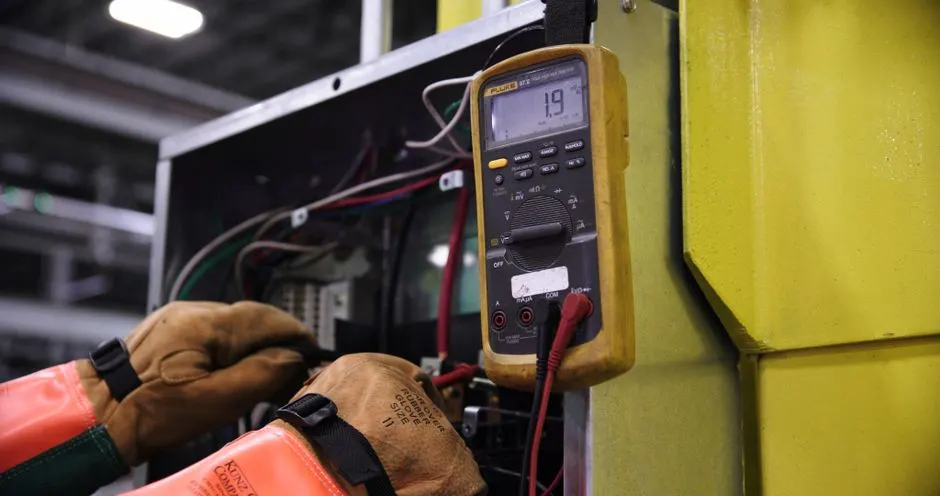
If you've been searching for Fast Electrical Troubleshooting Stockton CA, the first thing we do is measure voltage at the panel under load - not just at idle. That reading tells us whether the problem is inside your walls or on the utility side.
The five real causes of flickering lights and AC problems
Electrical flickering problems in Stockton, California almost always trace back to one of five causes. Here's how to narrow yours down.
1. Shared circuit between the AC and your lights
This is the most common cause we find. The AC condenser should be on its own dedicated 240-volt circuit, and the indoor air handler on another. In older homes, a previous owner or a shortcut-taking installer may have tapped the AC into a circuit that also feeds a bedroom, hallway, or garage lights. Every time the compressor starts, those lights dip.
The fix is straightforward: run a dedicated circuit from the panel to the AC. Depending on the run length and panel space, that's typically a half-day job.
2. Undersized electrical service
A 100 amp service was fine in 1965. It is not fine for a house running central AC, an electric range, a dryer, a pool pump, and two EV chargers. When your total load approaches the panel's capacity, every large motor startup drags the whole house voltage down.
If your lights flicker throughout the house - not just in one room - and your panel is 100 amps or older, an Expert Electrical Panel Upgrade Stockton CA to 200 amps is usually the right call. We see this constantly in the older neighborhoods near the University of the Pacific and along Pacific Avenue.
3. Loose neutral or bad connection
A loose neutral at the panel, meter base, or a junction box causes flickering that is more erratic than the steady dip from an AC startup. You may notice lights brightening and dimming randomly, or flickering in a pattern that doesn't match the AC cycle.
This one is serious. A loose neutral can send voltage spikes through your electronics and, in the worst case, start a fire inside a wall. If your flicker is unpredictable, stop using the circuit and call us.
4. Failing circuit breaker or worn panel bus
Breakers wear out. A breaker that's been tripping for years, or one that's 40 years old, may not hold solid contact under a surge. The result is arcing inside the panel and voltage instability downstream. If you hear a faint buzzing near the panel when the AC kicks on, that's a warning sign.
We replace these with a Trusted Circuit Breaker Replacement Stockton CA - a job that takes about an hour for a single breaker, longer if the panel bus itself is corroded.
5. Utility-side voltage sag
Sometimes the problem isn't in your house at all. If your neighbors see the same flicker at the same time, the issue is on PG&E's side - a transformer serving too many homes, or a service drop that's undersized for the neighborhood's current load. In that case, we document the readings and you contact PG&E. We can install a whole-home surge protector or a Dependable Generator Installation Stockton CA if you want backup protection during outages, but the utility has to fix the supply.
How to tell a nuisance flicker from a dangerous one
Not every flicker is an emergency. Use this quick test to sort out which one you have.
- Nuisance flicker: Happens only at AC startup, lasts less than a second, only affects lights on one circuit, and has been happening for years without getting worse.
- Concerning flicker: Lasts 2-3 seconds or longer, affects lights across multiple rooms, gets worse over time, or is accompanied by a burning smell, buzzing, or warm outlets.
- Emergency: Lights pulse bright and dim repeatedly, you see sparks, you smell burning, or a breaker trips every time the AC runs.
If you're in the second or third category, don't wait. A flicker that gets worse is a flicker that's telling you something is failing.
What to watch out for before you call anyone
Homeowners often make the problem worse by guessing at the cause. Here's what we see go wrong.
- Replacing the AC when the wiring is the problem. A new condenser on the same undersized circuit will flicker just as badly.
- Ignoring a 100 amp panel because "it's worked so far." Panels don't fail gracefully. They fail hot.
- DIY breaker swaps. Breakers are matched to the panel brand and bus rating. The wrong breaker can arc, melt, or void your insurance.
- Assuming it's the utility. PG&E only fixes the problem if it's on their side of the meter. Most flicker calls we run are inside the home.
- Letting a small flicker run for years. Loose connections don't tighten themselves. They corrode, heat up, and eventually fail.
If you're in the 95204 ZIP code and want a fast answer, we offer Electrician in Stockton CA 95204 service with same-week scheduling during cooling season.
When to call a professional
Call a licensed electrician for flickering lights in Stockton if the flicker lasts more than a second, affects more than one room, or has gotten worse in the last year. Those three signs point to a problem you cannot safely diagnose with a multimeter from the hardware store.
At Jensen Electric Services, we start every flicker call the same way: measure voltage at the panel under load, check the neutral and ground connections, and inspect the AC circuit for shared loads. Then we tell you exactly what's wrong and what it costs to fix before we start. No guesswork, no upsell.
If your home is over 40 years old and has never had an electrical inspection, this is also a good time to look at whether you need Safe Whole House Rewiring Services Stockton CA - especially if you've added an EV, a hot tub, or a second AC unit in the last decade.
Frequently Asked Questions
Why do my lights flicker when the AC turns on in Stockton CA?
Because the AC compressor draws a 3-5x startup surge that briefly drops voltage on the circuit feeding your lights. In Stockton, this is most common in older homes with 100 amp panels or shared AC/lighting circuits, especially on 100°F+ summer afternoons when the grid is already loaded.
Is flickering lights a serious electrical problem in Stockton, California?
It depends on the pattern. A brief flicker at AC startup is usually harmless. Flickering that lasts more than 2 seconds, affects multiple rooms, or comes with buzzing or a burning smell is serious and needs an electrician within 24 hours. Loose neutrals cause roughly 1 in 5 of the flicker calls we run.
How do I fix flickering lights in Stockton CA?
First, confirm the AC is on a dedicated circuit. If it isn't, that's the fix - usually a half-day job. If it is, the next steps are checking panel capacity, tightening neutral connections, and testing the breaker. Most flicker repairs run $250-$900 in 2026 depending on whether a panel upgrade is needed.
Should I call an electrician for flickering lights in Stockton?
Yes, if the flicker lasts more than a second, affects multiple rooms, or has gotten worse over time. A licensed electrician can measure voltage under load and find the cause in under an hour. DIY diagnosis on a live panel is how people get hurt.
Can a bad AC cause flickering lights?
Yes. A failing compressor, a bad run capacitor, or a shorted contactor can pull far more current than normal, which drags voltage down and flickers your lights. If your AC is also tripping its breaker or struggling to start, the unit itself may be part of the problem.
Get help with Electrician in Stockton
If your lights are flickering every time the AC kicks on, we can find the cause and fix it - usually in a single visit. Call Jensen Electric Services at (833) 363-1463 and we'll get a technician out to measure your panel, trace the circuit, and give you a straight answer.